Key takeaways
- Most storm-related basement water arrives from outside, pushed by saturated soil and hydrostatic pressure.
- Clean water, muddy water and sewage describe three different problems with three different cleanups.
- Gutters, downspout extensions and grading are the cheapest fixes and the first ones to check.
- Household fans and a dehumidifier rarely dry a storm-flooded basement fast enough to beat mold.
- Flood water from outside is usually excluded from a standard homeowners policy.
An Oklahoma basement that stays dry for months and then takes on water during a storm is telling you something specific. The water is coming from outside, not from a pipe. Saturated clay stops absorbing, the ground around the foundation fills up, and pressure pushes water through the weakest point it can find. That might be a crack, the joint where the wall meets the floor, a window well, or a floor drain that has nowhere to send the water.
Basements are less common here than in northern states, but walk-out basements, below-grade garages, storm cellars and crawlspaces are everywhere. The mechanics are the same, and so is the mistake homeowners make: drying the visible puddle without finding the entry point. Basement water damage is its own scope for that reason.
Where the Water Comes From
Hydrostatic pressure
Expansive clay is the main character. When it soaks up storm water it swells, and the soil against the foundation pushes inward. Water follows the pressure through hairline cracks, the cove joint, or the porous block itself. This is why the wet line often appears at the base of the wall rather than at a window.
A sump that cannot keep up
A sump pit with a pump that runs constantly during a storm is doing its job. A pit that fills and does not pump has a failed pump, a tripped circuit, or a float stuck in debris. Power outages during storms are the other common failure, which is why a battery backup matters more than a bigger pump.
Failed or missing drainage
Footer drains clog with silt over decades. Window wells fill with leaves. A downspout that discharges two feet from the wall puts thousands of gallons against the foundation during a heavy rain. Each of these produces a wet basement that looks identical from the inside.
Sewer or drain backup
If the water smells like sewage or comes up through a floor drain while other fixtures are draining slowly, the municipal line may be surcharged or the house lateral may be blocked. That is a different call: contaminated water, different protective equipment, and often a plumber before a restoration crew.
Clean, Muddy or Sewage: Why It Matters
Restoration crews classify water by what it has touched. Rain that enters through a window well and crosses a clean floor is close to category 2. Water that crosses soil, picks up silt and runs across a garage floor is category 2 or 3. Sewage backup is category 3 and always requires removal and disinfection rather than drying in place.
The category decides what can be saved. Carpet and pad touched by muddy storm water are removed. Drywall that has absorbed contaminated water is cut above the wet line. A clean supply-line leak in the same basement might be dried in place. Two basements with the same depth of water can have completely different scopes.
What to Do in the First Two Hours
- Keep people and pets out of the water. If it is near outlets or the panel, do not enter the room.
- Shut off the power to the basement at the breaker only if you can reach the panel on dry ground.
- Stop adding water: shut off the supply if a pipe is involved, and check that downspouts are not dumping at the wall.
- Photograph the water level against the wall, the entry points, and anything damaged.
- Move valuables up and out, but do not walk through contaminated water to do it.
- Call the dispatch line and describe the color and smell of the water.
Do not run a household vacuum in standing water. Do not leave cardboard boxes, rugs or upholstered furniture sitting in it. And do not assume a wet vacuum and a fan will be enough after a storm; the volume and the contamination usually say otherwise.
Water rising in the basement? Call (833) 781-1831. Tell the dispatcher whether the water is clear, muddy or sewage, and whether the power is still on in that area.
Drying a Basement Properly
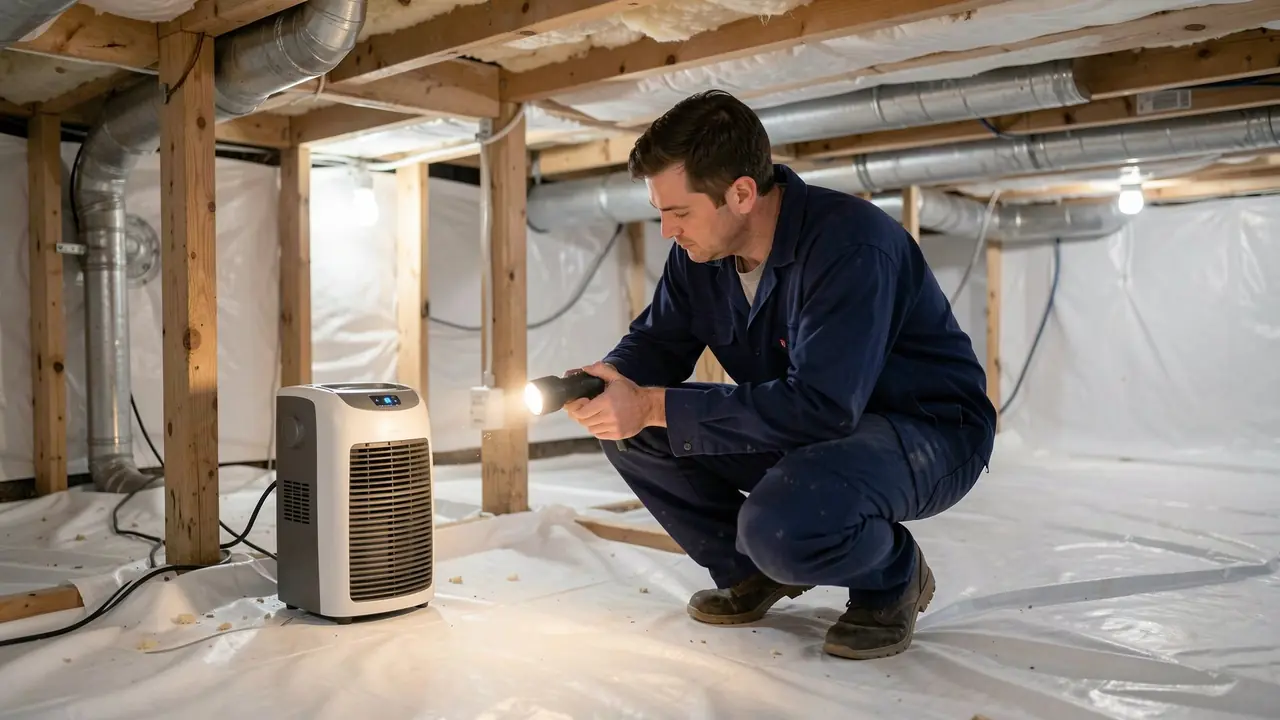
Concrete, block and framing hold water longer than they look like they do. A basement that feels dry to the hand can still be reading high on a meter. The standard approach is extraction, removal of material that cannot be saved, then air movers and dehumidifiers with daily readings on the walls, floor and any framing.
Two things are different below grade. First, the space is often cooler, which slows evaporation and means equipment runs longer. Second, humidity has nowhere to go unless a dehumidifier is pulling it out. Opening a window in a humid Oklahoma summer can make the problem worse. Closed-door drying with controlled equipment is usually the right call.
If the water was contaminated, the sequence starts with removal and antimicrobial work before drying, which is the same approach used in flood damage cleanup. Porous material that stayed wet for more than a day or two is a mold concern even when it looks salvageable.
Fixes That Actually Keep Water Out
| Symptom | Usual fix |
|---|---|
| Water at the wall base after rain | Improve grading, extend downspouts, seal the cove joint, consider interior drainage |
| Water through a wall crack | Polyurethane or epoxy crack injection, plus drainage if pressure is the cause |
| Water at a window well | Clean the well, repair the cover, add a drain if it fills |
| Sump runs constantly | Verify the pump, add battery backup, check the discharge line and check valve |
| Water up through a floor drain | Camera the lateral, install a backwater valve if the municipal line surcharges |
| Damp walls, no puddle | Vapour management and dehumidification, not more paint |
No single product fixes every basement. A crack injection does nothing for a clogged footer drain. A new sump does nothing for a downspout dumping at the corner. The entry point decides the fix, which is why the first visit should be diagnostic rather than a sales pitch.
Insurance Reality in Oklahoma
Water that enters from outside the foundation is generally treated as flood. Standard homeowners policies exclude it, and a separate flood policy is required. Water from a burst pipe or a failed water heater inside the basement is usually covered as sudden and accidental damage. Sump overflow and sewer backup sit in between and often need an endorsement.
Documentation matters either way. Photograph the water line, the entry point, the damaged contents and any receipts for emergency supplies. Keep a written timeline of when the water appeared and how high it got. Adjusters work from evidence, and a claim filed days later with no photographs is much harder to support.
The Mold Clock
Mold can begin growing on wet drywall, carpet backing and framing within 24 to 48 hours. A basement is already dark, often warm, and poorly ventilated, which is close to ideal. That is why the goal after a storm is not just to remove the water but to dry the structure fast enough that growth never starts. If the space was wet for more than two days, ask the crew to check for mold before the repair phase begins.